Search Lil' Blogger

Monday, 16 November 2015

BAPP Task 2d: Inquiry

For this task I wanted to think outside the box. I wanted to combine the ideas that are flitting about in my brain to form the basic lines of my future inquiry...

Where do I start? Where do I want to put my focus? What do I do on a daily basis that I can incorporate?

Using these questions, as well as reflecting on my blog and my previous research, I have fallen upon key words, strands of thought and resulting ideas that I would like to elaborate on. As I am not in full-time work I found some of the questions posed in Task 2d from Reader 2 (you will see these below), rather difficult to answer as I do not have a set daily routine of working in the same environment with the same people. I spend some days studying at the Middlesex University campus, I spend others studying at home, I work 2-3 days in Selfridges and I have my steady Saturday job at English National Ballet School (ENBS) on their Juniors programme. My week consists of such a mixture of activities and experiences that it is challenging to just focus on one of them and put my energy into writing an inquiry about themes that are relatable to one specific thing.

However when I started to think of the bigger picture, rather than focusing on having to write about one specific area of professional practice that I encounter during my week; I noticed themes that caught my attention and made me think in greater depth about what interests me and how I can use it moving forwards.  

I have answered the following questions in a way that best suits the direction in which I wish to go with my inquiry. My answers may not be straight forward and may not reflect a particular area of my professional practice, but they do contain areas of significance to me.
  
1. What in your daily practice gets you really enthusiastic to find out more about? Who do you admire who also works with what makes you enthusiastic?

The Law makes me very enthusiastic. I am currently studying and working through a fast track A Level in Law which requires me to study, through distance learning, 4 modules with 4 exams to be taken next summer. The only way I find the motivation to study something as in-depth and intricate as this, and all off my own back, is because of my sincere interest in this area of our society. It is something that I want to pursue in the future once I have, with hope and hard work, completed the BAPP programme. It is something I make an effort to do each day, or as often as I can when I am working, and I have been thinking long and hard about how I can incorporate it into my line of inquiry. It is something that I feel proud of doing and I look forward to that sense of accomplishment as I progress with it in the future.

It is difficult to pin point someone who makes me enthusiastic in this area as, at the moment, it is very much something that I am doing alone. I can only think of the inspiration and the drive that my friends and family build up around me. They inspire me to want to work hard at something that makes me happy and makes me feel like I am achieving something for myself. Aside from this, I do wholly admire those individuals who want to go into a prestigious subject, such as Law, who have not necessarily been down the traditional education route. My path has been a interesting one to say the least. Training to become a professional ballet dancer for years to then decide to pursue something completely different without all of the traditional qualifications behind me is an unusual one. But it is a completely reachable goal, especially if you look at all of the other options out there that can allow you to fulfill your aspirations. It makes something that seems impossible in the moment, to becoming totally possible if you put your mind to it and expect some testing times along the way. 


2. What gets you angry or makes you sad? Who do you admire who shares your feelings or has found a way to work around the sadness or anger?

Anger and sadness. Feelings of mine that can surface if I am stressed, tired, feeling disorganised or behind in something, or having a bad experience with a customer at work. This sounds like an extensive list of things that can make me angry or sad but, being openly honest, it is not often that I do get angry or particularly sad. I like to think optimistically; a cup half full not half empty type of girl. It is in those times when we do feel those emotions bubbling up inside, that it is good to take a moment to yourself; to rest, to regroup, to put a positive spin on whatever experiences you have had or are having.

During my work on a Saturday, I assist in teaching 8 ballet classes with a wonderful teacher who takes charge and leads the structure and content of the classes. It is this individual who inspires me in times when my patience may be running thin or I am becoming worried about the progression of the children reflecting poorly on the teachers. She reminds me that there is only so much we can do and that as long as we are trying our best to engage with the children, to push them just hard enough and to introduce to them all the necessary ballet vocabulary for their age, then we are fulfilling our roles.       

3. What do you love about what you do? Who do you admire who also seems to love this or is an example of what you love?

There are many things that I love about what I do depending on what area of my life I choose to focus on.

With Law Study I love...
- the level of academic content
- having quiet study time
- accomplishing something for myself that will help to point me in the right direction for what I desire in the future
- learning something new all the time
- grasping such an essential area of our society
- imagining making a difference with it in the future

With Selfridges I love...
- having friendly and welcoming colleagues
- meeting new people everyday
- building on my people skills (customer service)
- working in such a luxurious environment

With ENBS Juniors I love...
- being involved with ballet as an art form
- assisting children in learning and progressing in ballet
- having a wonderful teacher and pianist to work with
- training potential dancer's of the future 

This is definitely a shortened version of what I love about my professional practice! It is so thrilling to be part of a university and experience student life as well as being able to interact with so many people at Selfridges, and teach children the art form that I love the most on a weekly basis at ENBS.

I am privileged to be able to work with so many inspirational, hard working and enthusiastic people each and every week, no matter what field they are in. I admire my friends at university for all the hard work and love they put into their own areas of study; I admire the  talented make-up artists, fashionistas and salespeople I meet at Selfridges; and I admire the dedication and determination to strive for excellence amongst those I work with at ENBS. 

4. What do you feel you don't understand? Who do you admire who does seem to understand it or who has found a way of making not understanding it interesting or beautiful, or has asked the same questions as you?

I sometimes cannot understand how, when in such a prestigious and inspiring environment, some (not many) of the children that I teach ballet to give the impression that they do not wish to participate. When I was their age, I would have given anything to have taken weekly classes at English National Ballet School and to be amongst the students who are training at a professional level. Really how many 4 year olds can say that they learn ballet at one of the most renowned places of classical training. Yet the odd few still choose to be unresponsive and uncommitted to their ballet class, even though it takes up no more than an hour of their week. 

I must highlight however that the majority of the children are excited to be there and probably feel very lucky to be given the opportunity to learn ballet in a place that they are inspired by and in awe of. I regularly have parents approach me and comment on how much their child loves ballet, how it is the highlight of their week and how they cannot wait to get into the studio to learn. I do see these features in many of the children, but it is always upsetting to me to see those who maybe do not want to be there and are not prepared to give full effort. I do of course understand that ballet is not for everyone, some will find it more of a challenge than others and yes, maybe they do not truly want to take part. But to a teacher this is a difficult thing to work with as you have to remain as enthusiastic and as encouraging as possible, even if you observe poor effort from the minority.

I have had discussions surrounding this basis with my colleague at English National Ballet School who teaches alongside me. She often feels as frustrated as I do in these situations and cannot understand why the children do not always want to be fully determined to work hard. But she has found a way of putting a positive spin on these issues looking at the fact that we do the best that we can, and it is up to the children to then meet us half way and want to engage with us. She always manages to remain a positive, energetic and committed teacher turning, what can be very negative questions into something quite beautiful.       

5. How do you decide the appropriate ethical response in a given situation? To what extent are disciplinary responses different to what you might expect more generally in society? For example, what level of physical contact would you deem appropriate (and not) from another professional that you would find unacceptable more generally? Why?

The area in which I am required to think the most about appropriate ethical responses is when I am working with children at English National Ballet School. During the ballet classes, it is important to maintain a sense of discipline for the children to respond to yet at the same time, you have to make learning fun and engaging so as not to make the children feel worried or negative about what they are doing.

The children that I work with are very young and therefore; at an age when they are easily so influenced; it is important to build their confidence rather than allowing the stricter elements of learning ballet to take over. For me it is all about finding a balance between being firm to make sure that they behave appropriately, whilst simultaneously creating a lively and enjoyable environment. It is about earning the respect from your students and expecting them to be quiet when told or to concentrate and focus on what you have asked of them. Again, due to their age, they can get easily distracted and so it is a constant battle with their minds to keep them responding fully to what exercises you are setting during class.

Working with an age range of 3 to 11 year olds, you have to gage what each group of children will respond to the best. With some classes I have noticed that you need to be much firmer giving possible sanctions for misbehavior such as sitting out and not participating or, in more extreme cases, being sent out if the disruption is affecting the other children too severely. On the other side of this, certain groups of children need constant positive feedback and encouragement in order to motivate themselves during class. I on the whole believe that it is essential to be an encouraging and positive teacher otherwise you run the risk of mentally affecting your students in a counter-productive way making them feel defeated and inadequate. Of course you must maintain and aura of discipline and respect, but do it in a way that actually makes the children want to respect you rather than fear or dislike you.   

Within the ballet profession, it is completely normal to have physical contact between a teacher and a student in order to correct the body sufficiently and allow it to respond in the right way. Therefore, in a dance environment, you would not be shocked to see a teacher physically touching their student (in an appropriate way) with the purpose of correcting them. Yet in most other professions, meaning external to the dance and even the sporting arena, it would be far more inappropriate to have physical contact with a student or a colleague. Society views physical contact in an environment such as in an office or a school, to be highly unsuitable and unprofessional. I must admit that if I was to witness, for example, a teacher in a high school touching another student in a way similar to what ballet training requires, I would be shocked, disturbed and tempted to report them. How fascinating it is to notice that, across the spectrum of different types of training and education, physical contact is such a sensitive subject matter that can be perceived as being immensely inappropriate if done in a certain environment. 
  ----------------------------------------------------------------------------------------------------------------------

Now that these questions have been answered, I want to specifically hone in on what I want my inquiry to be based around. Scanning through my previous blogs, I found terms which, when broken down, helped me to arrive at destinations from which I feel I could develop an inquiry of great interest to me. The terms are as follows:


CHANGE: because I have recently experience colossal life changes with regards to what my future may hold and the path that I have chosen to pursue

AGENCY: because I am acting independently and making my own choices therefore setting change in motion

PASSION: because it motivates and drives me everyday to carry on working hard and achieve my goals

DEVELOPMENT: because I feel I have developed mentally and now use successful methods of reflection to oversee my development

From these terms I then thought:

How can I further change my own life and potentially change others' lives in the future, doing something that I am passionate about which will exercise my agency and fuel my development?  

-----------------------------------------------------------------------------------------------------------------------


Afterthought...

An aspiration of mine is to study and finally practice Law. I find, and have always found it, a fascinating subject with such a diverse range of areas to be practiced. As a subject of study it requires patience, hard work, a sharp, logical mind and definitely someone who enjoys reading. Additional to this, confidence, self assurance, determination, a handful of grit and a love of researching, presenting evidence and doing what's best for whoever you are representing collectively make a great lawyer.

You're probably wondering how this is relevant to the BAPP Programme but I guess the idea is that we can find interest in, research and pursue whatever we like so long as we can relate it to professional practice.

To me, practicing Law doesn't have to be all about paperwork, reading, writing and becoming a slave to the office. Although this is of course involved to a certain degree, I like to think of it as a profession that gives you the power to help people, change minds, alter opinions and allow the justice system to evolve.

I often imagine the courtroom to be a sort of stage, a forum within which, when it is time for you to present your case, all eyes are on you and whatever you say and do holds much responsibility and meaning to whoever is involved. Many of us throughout of lives have had to perform in front of an audience be it through singing, dancing, acting etc. Well I like to argue that representing someone in court is similar to this. You have to be confident, speak publicly, argue, fight and put on a show. Although this time the show is not scripted, choreographed, rehearsed, performed then its time to go home. No! It is real life, real people and their futures are involved; that just makes it all the more thrilling!

Now that I have expressed my enthusiasm for this incredible industry I'd like to talk about my own, although at present limited experience, in this area. Earlier this year and as a resident of the Big Smoke, I took myself off to the Old Bailey, London's Central Criminal Court just northwest of St. Paul's Cathedral. Rebuilt in 1673 following the Great Fire of London less than 10 years before, it is a grand, intimidating piece of architecture within which thousands of people create a hub of intense activity on a daily basis.

I went through security checks and was instantly dazzled by the architectural beauty and magnificence of the buildings décor. The ceiling reached an amazing height, there were long corridors everywhere with imposing wooden doorways and regular signs pointing you in the direction of the many courtrooms. So being the curious person that I am, I went exploring around the huge site, eager to absorb all of the fascinating history within its walls. Eventually I found a courtroom with a trial in session. I quietly slipped inside and sat myself down in the public gallery. Wow! It was the first time I had ever experienced such an environment and I cannot deny how much it inspired me to pursue Law. I really do hope to go again soon and add to my experiences of this captivating world.

I have been thinking fiercely about how I can relate this fundamental element of our society to my final inquiry. Within this vast subject I have chosen to focus on how artistes, no matter what area of the arts or entertainment profession that they are in, are represented in our society. How do they go about ensuring that they receive the correct pay; a fair contract; equal treatment; a good standard of living; avoid exploitation; have mental and physical health care etc. I want to look at the legal side of an artistes profession and what goes in to ensuring that they have secure employment and sufficient legal representation if needs be. By choosing this subject, I am incorporating change, agency, passion and development; themes which I was originally inspired by and have used to evolve my ideas.


I have lots to think about and research here; let me know what you think!

Lil' Blogger 


Monday, 9 November 2015

BAPP Task 2c: Reflective Theory

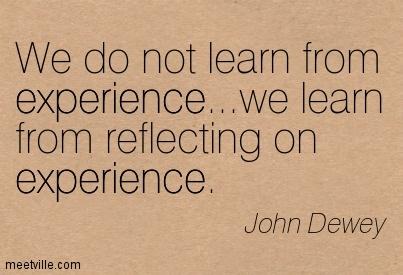
The self is not something ready-made, but something in continuous formation through choice of action.
(Dewey, undated, np)


The theory of reflection can be interpreted in so many ways completely depending on the individual. It is a universally recognised thing that we, as human beings, naturally like to dwell upon past experiences and look forward to future ones. During this process, a person can learn so much about themselves and those around them who are involved in their life. It could be a traumatic or a cherished experience that they subconsciously keep coming back to, but it is only when such experiences are worked through that reflection can thrive, thus allowing us to progress with our lives and build a more stable future.

For myself, reflection certainly occurs the most when I look back at things that I have gone through in my life, whether good or bad, and find a way to use them to make me a stronger person and benefit my present/future self. A large portion of this reflection happens inwardly in my mind where I think about and analyse experiences until I arrive at a place where I understand them and can take something advantageous from them. 

At times this can be a challenging way to reflect as you find that your emotions surrounding an event go wild and can cloud your judgement on how you may truly be feeling about something. Therefore I have discovered that rational thinking is essential in reflection. Yes it is good to allow your feelings to influence the way you reflect and further act but this simultaneously needs to be met with rational thinking where you are logical and sensible about a situation.

Alongside my constant inward reflection sits the method of journal writing. As expressed in a previous blog of mine, it is something that I took a great liking to in the past and therefore it has been an interesting form of reflection for me to reintroduce into my life. I cannot say that it was an immediately easy thing to do as I had to discover the best way for me to reflect through my journal. Now that I have found the methods which best suit my way of thinking, I can write freely when I so wish, giving me the ability to look back over days gone past and take something, anything from them.

Journal writing has in fact reminded me of how important it is to take the time to reflect on a daily basis, if possible, or simply as often and as easily as you can. It does not have to be a complicated or difficult thing to do and once you have become comfortable with personal reflection, you can continue to develop the methods you use to do so. 


As an individual passes from one situation to another, his world, his environment, expands or contracts. He does not find himself living in another world but in a different part or aspect of one and the same world. What he has learned in the way of knowledge and skill in one situation becomes an instrument of understanding and dealing effectively with the situations which follow. The process goes on as long as life and learning continue. Otherwise the course of experience is disorderly, since the individual factor that enters into making an experience is split. A divided world, a world whose parts and aspects do not hang together, is at once a sign and a cause of a divided personality. When the splitting-up reaches a certain point we call the person insane. A fully integrated personality, on the other hand, exists only when successive experiences are integrated with one another. It can be built up only as a world of related objects is constructed.
(Dewey, 1938, np) 


As an active critical thinker, I like to be aware of how I can improve my methods of thinking. It is very easy to get stuck into the same routine of thinking as we are very much so creatures of habit. I feel that it is so important to be able to experiment with your thinking for the cause of self-development. If we do not welcome change into our lives and take a step to do something new, we will never fully discover ourselves or the world around us. For me, the BAPP programme is opening up so many doors for new, active thinking that I can introduce into my life. I am learning about reflective methods and the philosophers who created them, something which I previously had very little knowledge of. It is immensely fascinating for me to finally dig deep into my own mind to try and figure out how I like to reflect and whether I have been doing it in a way that best suits. The more I reflect, the more I learn and it is a process that is ever-changing and developing throughout my everyday life.     
Looking at the work of Dewey, as quoted above, he emphasises how the ever-transitioning world around us can act as an instrument for bettering our understanding thus improving how we will act in future situations. The skills that we pick up along the way from experiences in our lives help us to learn, grow and become more intelligent about and aware of our surroundings and the people within them. It is a constant process of evolution which each and every one of us goes through day after day after day. Without it, we are not complete. We cease to grasp the fullness of our experiences and use them to our own advantage. As Dewey mentions, a "fully integrated personality" built upon successfully assimilating our experiences, is what enables us to function effectively. From this I have taken the idea that by stringing my experiences together I can construct a map of where I have been in my life and where I want to go. This will help me to methodically work through and progress in my critical thinking whilst simultaneously picking up new experiences and resulting ideas along the way.  


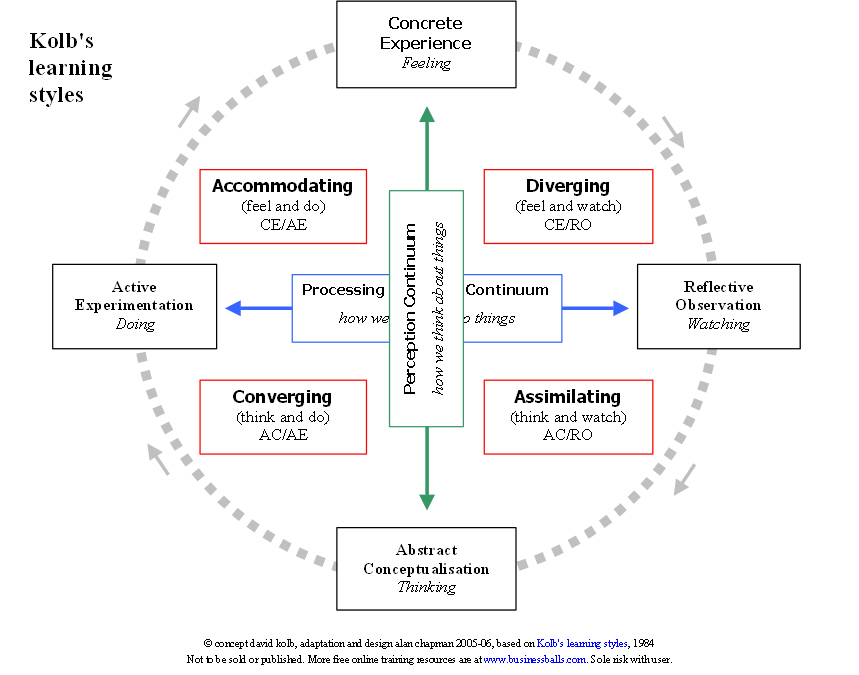
Onward to David A. Kolb, he (as discussed in a previous blog of mine) established a cyclical process through which your experiences can be reviewed and analysed. This process creates a logical system of reflection using the following four principles:

  1. Concrete Experience
  2. Reflective Observation
  3. Abstract Conceptualisation 
  4. Active Experimentation
You can gather from the diagram below how Kolb integrates these 4 principles with; Diverging; Assimilating; Converging; and Accommodating. He has succeeded in bringing together a logical cycle of reflection combined with different learning styles that will vary from person to person. Following his model allows an individual to touch on all bases of reflection (so experiencing, thinking and acting) and to do so in their own way depending on their preferred learning style.  


kolb's learning styles diagram


Amongst those in the education sector, methods of learning can be praised and hailed as effective ways for young people to develop and learn throughout their time at school. However on the other side of this, learning methods such as Kolb's have been criticised in the past by certain educationalists and educational researchers. In summary, many view learning models, theories, instruments etc., as being largely counter-productive in young people's education. Scientific research into this area has emphasised how questionable the benefit of relying on various learning styles actually is. 

I think that this highlights how, when working with young people, it is hugely important to use learning methods which are well responded to and are seen to have considerable benefit amongst those using them. There is absolutely no point in using a method just for the sake of using it if, once under assessment and review, it is not proving to be effective. For me also I am unsure as to how much Kolb's model in particular, actually assists me in my critical thinking and subsequent reflection. For me, a learning methodology or concept needs to click very soon after I have started using it. If I am not responding well to something and am finding it difficult to adopt, I will mostly go about things my own way and learn through processes which I find the most enjoyable and adaptable to myself. For instance I find that I get the most out of study by writing things down, making concise notes and having them there to go back to whenever I need. I think this is why journal writing is such a useful tool for me as I know that I have something that I can pick up for the purpose of discovering ideas that may be useful to me in that moment or in the future.  


Reflective practice is a dialogue of thinking and doing through which I become more skilful.
(Schön, undated, np)

Donald Schön's idea of using reflection-in-action or reflection-on-action (as discussed in a previous blog of mine) has actually been really helpful to me. I use both on a regular basis and feel that his very rational way of thinking about reflection has made the idea of it much clearer in my mind. If I am using either one of the two processes, I can identify straight away what it is I am wanting to achieve from my reflection at that time, whether it is during a practical activity or simply sitting quietly and mulling over what I have done. I feel that both methods of reflection coexist to make an individual a successful reflective practitioner. Having one without the other stops you from fully benefiting from your activities and therefore progressing at a pace that is your best. 

As emphasised in the quote above; I like how Schön believes strongly in the use of reflective practice as a way of becoming more rounded, knowledgeable and skilful. His views on reflective practice sit parallel with what we, as students on the BAPP programme, wish to achieve in our own lives and through this course. I have found that my reflection has almost become a constant dialogue that runs through my mind, and that without it I am not fully engaging with what I am doing or wishing to achieve. Simply by reading back over my previous blogs I can spur on my inward reflection and think about the concepts that I have explored; whether I would interpret them differently now; and how I can go about developing them further.     
  

Donald Schön


Reflection lies somewhere around the notion of learning and thinking.  We reflect in order to learn something, or we learn as a result of reflecting.
(Moon, 2004, p 4) 


Finally I would like to approach the work of Jenny Moon, an educationalist who I have not yet explored in depth. She interestingly likes to define how our use of any reflective model can be shaped by our underlying reasons for using it. Through this Moon looks at our processes, our goals and our methods of assessment when we come to doing a reflection on different types of situations, be them professional or personal. 

For instance, if you were to write a personal reflection on an experience, you may reflect in a more inward manner expressing far more intimate and private thoughts and feelings. You would be able to explore whatever subject matter you so wished and write it up in a way that may only be clear to you and no one else. No formality or spotless grammar would be necessary as it is your personal reflection to keep and go back to.Yet on the other side of this if you were, for example, to reflect on an important essay that you have written, you may make some notes about ways you can improve it; you may seek advice from a professional; you would be aware of maintaining good grammar and clarity in your writing; and the subject matter may have been chosen for you.

These two differing situations of reflection prove that, as highlighted by Moon, the reflective models that we use will be influenced by whatever we are using them for. How we reflect is utterly dependent on what the focus is for that specific activity hence why we adapt our reflective methods to best suit the task in hand. My journal is my personal way of reflecting; I don't have to worry about it being well written, legible to others or upholding formalities. I can just write in whatever way I wish knowing that it is for my eyes only.Yet if I were to read an essay of mine for the purpose of redrafting it, I would reflect in a totally different way using clear, concise notes, gathered research and a caution for good grammar.

To finish, there are so many reflective theories out there, both old and new, and all will work to differing levels of success for each individual. It is important for us to not get frustrated if a method doesn't work out or we cannot connect to its concepts. Finding reflective theories that work for you starts with a process of trial and error. Go and grasp some of the methods, try them out for yourself and if they do not work, move on and try something new. There is always something out there for us to learn about so take pride in how you go about this.


Lil' Blogger


Dewey, John (1938) Experience and Education, Kappa Delta Pi Lecture Series

Dewey, John (undated) quote sourced from https://www.goodreads.com/work/quotes/72810-experience-and-education  (accessed 09.11.15) 

Moon, Jenny (2004) A Handbook of Reflective and Experiential Learning , Routledge Falmer, London

Schön, Donald (undated) quote sourced from http://www.toolshero.com/toolsheroes/donald-schon/ (accessed 09.11.15)

Wednesday, 4 November 2015

BAPP Task 2b: Journal Writing Experience

Following a Skype session on Tuesday evening, I have thought long and hard about how I want to approach writing my journal. I had some reassuring feedback from fellow BAPP students who expressed that they too, to begin with, found it a challenge to get going with journal writing without feeling that they were doing it all wrong.

Interestingly it was raised that; how can you be doing wrong if it is your thoughts that you are expressing? This is, in my opinion, a fascinating and very true statement. If it is your thoughts, feelings and opinions that are being written down, how can they be wrong? We should be able to have confidence in what we express and not fear judgement or the thought of getting it 'wrong'. So, as of this week, my journal is up and running and I am finding my feet with how I best like to write it. 

Looking into the different methods of journal writing:

Description
List
Initial Reflection
Evaluation
Plan of Action 
What if?
Another view
Graphs, diagrams and drawings
Stream of consciousness...

...I have found that using visual methods (graphs, diagrams, charts etc.) does not work so well for me. I find it difficult to connect with my thoughts in this way and much prefer to use:

List
Stream of consciousness
Description

These three forms of journal writing work for me as I am able to just write. Something I take enjoyment in and therefore feel more able to do quite freely and openly. I like to think methodically and logically so list writing really helped me to just jot down what I had done that day and then look at each thing and ask myself how I benefitted/learnt from it. 

Similarly with stream of consciousness and description, I could write about my day without putting too much thought into it (which for me causes a writing block) and just allow my thoughts, feelings and ideas to develop naturally.

On Wednesday I wrote:

"So now I am sitting on the tube and finding it rather pleasant to write in my journal and reflect on my day. It's amazing how such subtle, insignificant things that happen to you throughout the day can later have an impact. When you look back at something that happened you can take something from it and discovered little ideas which will develop and eventually blossom".

Also in this entry I noted down little thoughts that spurred me on to think of the bigger picture about what I can further pursue in my studies on the BAPP course. These ideas stemmed from my day working in Selfridges and what skills I feel I have built upon since working there. 

So all in all I'm finding it such a productive and useful tool to get stuck into my journal! Always remember to not be afraid of just expressing yourself through your journal in whatever way you feel comfortable, as more often than not something interesting will result.

Lil' Blogger 


Tuesday, 3 November 2015

BAPP Task 1a: Professional Profile (CV) Second Draft

I just wanted to further update my professional profile, adding in more about my current employment and also my skills. I feel it is important to display your skills on a CV to give the potential employer an idea of what type of person you are and whether you are suitable for a particular job. It is a good idea to sell yourself and describe your best assets as employers may be attracted to these and wish to consider you further for employment. 

Feedback welcome!

Lil' Blogger

Lily Jane Grundy


English National Ballet School Graduate 2015  

Date of Birth: 01.09.1995  
   
Age: 20    
      
Nationality: British  


Education
09/2012-06/2015:
English National Ballet School, Trinity College London Level 6 National Diploma in Professional Dance 

09/2012-05/2014:
The Benesh Institute, Benesh Movement Notation: Score Reading for Dancers, awarded Honours 


09/2012-08/2014:
Oxford College Distance Learning, A Level History, awarded A

   
Elmhurst School for Dance, GCSE:

09/2010-06/2012:
  • English Language: A* 
  • English Literature: A* 
  • History: A* 
  • Religious Studies: A* 
  • Art and Design: A 
  • Dance: A* 
  • Drama: A 
  • Science: B 
  • Additional Science: A*      
09/2010-06/2011:
  • Mathematics: A   

Currently Studying
09/2015-present:
BA Honours in Professional Practice (Arts), Middlesex University

09/2015-present:
Fast Track A Level Law, Oxford College Distance Learning
    

Performance Experience
10-11/2014: 
Swan Lake (Deane) corps de ballet, English National Ballet, Palace Theatre, Manchester; Liverpool Empire, Liverpool
   
7/2014: 
Napoli Act 1, Balabile (Bournonville, staged by Dinna Bijrn) solo and corps de ballet; Undefined (Day, Francis-Martin, Marko, Sullivan), ENBS Summer Showcase, Wimbledon
Theatre, London
  
4-5/2014: 
My First Ballet: Coppélia (Williamson after Hynd) Innkeeper, Chinese Doll and Friend,Theatre Severn, Shrewsbury; Peacock Theatre, London; Assembly Hall Theatre, Tunbridge Wells; New Victoria Theatre, Woking; Waterside Theatre, Aylesbury
  
12/2013: 
Relentless (Bould, Bautista, Grundy, Nightingale) quartet, ENBS Christmas Showcase, ENBS Studio Theatre

7/2013: 
The Sleeping Beauty, Garland Dance (MacMillan); Interpulse (Campos); Soirées Musicales (MacMillan), ENBS Summer Showcase, Wimbledon Theatre, London
  
12/2012: 
Coppélia Act 3, Dance of the Hours (Hynd); Contemporary Solo (Grundy), ENBS Christmas Showcase, ENBS Studio Theatre  


Work Experience
9-11/2014: 
Swan Lake (Deane) corps de ballet, English National Ballet, Palace Theatre, Manchester; Liverpool Empire, Liverpool

7/2013-11/2014: 
Food and Beverages Assistant, Delicious Tearooms, Trentham Gardens Estate, Staffordshire

09/2015-present:
Teaching Assistant, English National Ballet School, Juniors Programme, Chelsea, London


10/2015-present:
Temporary Sales Assistant, Beauty Consultants Bureau, London


Vocational Training 
9/2012-7/2015: 
English National Ballet School, London 

9/2007-7/2012: 
Elmhurst School For Dance 

Skills:
I am an inquisitive, eager, passionate individual with excellent inter-personal and communication skills. I am exceedingly organised, efficient and quick to learn and am very familiar with working both alone and within a team. I always take a positive approach to my work and maintain an air of approachability. My natural ambition forces me to continually strive to perform at my best in whatever I am doing. My articulateness and undoubtedly good retention skills allow me to absorb information and complete tasks to an excellent level. My motivation and punctuality make me a decidedly productive and reliable individual and there is nothing I love more than keeping busy and being challenged.